SAT® Topics
Don't just test. Master the content.
Test Taking Strategy
While there is no substitute for learning the underlying math on the SAT, test-taking strategy can get you very far. So master these fundamentals before going too deep into the underlying content.
The SAT Math section tests your mathematical reasoning skills across many topics.
Basic Strategy
Basic Strategy allows you to answer questions correctly, even if you are a little shaky on the underlying mathematics. Whether you are picking numbers or spamming Desmos, master these essential skills first.
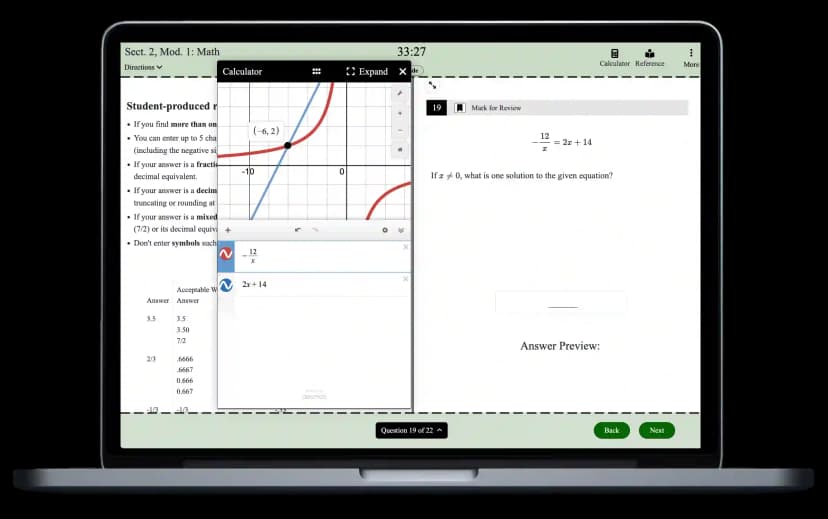
Desmos Skills
Unlock the power of your graphing calculator and watch your SAT math scores climb to new heights! The key lies in recognizing when to abandon tedious hand calculations and embrace Desmos Skills instead. Master the strategic use of graphing functions, solving systems of equations, and using regressions to crush challenging problems with lightning speed. When you encounter those brutal module two questions designed to drain your time with complex computations, discover how to outsmart the test makers by leveraging your calculator's full potential and solve with the efficiency of a true math champion!
Picking Numbers
Transform abstract algebra into simple arithmetic and demolish SAT math problems with confidence! One secret weapon of top scorers lies in mastering Picking Numbers, the strategy that converts intimidating variables into concrete, workable values. Learn to substitute smart numbers for variables, simplify polynomial relationships, and turn bewildering word problems into straightforward calculations. When facing nightmare questions with tangled algebraic expressions, discover how choosing the right numbers illuminates the solution—transforming advanced mathematics into basic arithmetic anyone can master!
Algebra
Algebra questions test your understanding of linear relationships, systems of equations, and functions. Master these fundamental concepts to solve complex problems effectively.
Lines and Linear Relationships
Build an unshakeable foundation in linear relationships and watch your SAT algebra confidence skyrocket! Every successful test-taker must command Lines and Linear Relationships—the cornerstone of Algebra 1 that unlocks countless math problems. Master the essential skills of finding equations from two points, working with slope-intercept form, identifying parallel and perpendicular lines, calculating intercepts, and analyzing graphs and tables. Develop fluency in finding intersection points, determining average rates of change, and applying transformations to linear functions. This fundamental topic appears throughout the entire SAT math section, making it your most valuable investment for consistent high scores across every type of problem you'll encounter!
Basic Algebra
Master the building blocks of algebra and unlock your pathway to SAT math success! Basic Algebra forms the bedrock of every advanced concept you'll encounter—without these core skills, higher-level problems become impossible mountains to climb. Develop lightning-fast proficiency in combining like terms, executing clean equation solving, manipulating fractions with confidence, and finding common denominators effortlessly. These fundamental techniques aren't just standalone skills—they're the essential tools that appear in virtually every SAT math question, from simple linear equations to complex polynomial expressions. Nail these basics and you'll have the rock-solid foundation needed to tackle any algebraic challenge the test throws your way!
Systems of Equations
Conquer the interconnected world of multiple equations and achieve flawless accuracy on every systems problem! Systems of Equations challenges you to think strategically about relationships between variables, whether you're solving two equations with one unknown, tackling classic two-variable systems, translating word problems into mathematical language, or interpreting graphical intersections. While Desmos can streamline calculations, true mastery comes from understanding when to use substitution, elimination, or graphical methods to guarantee correct solutions. Perfect your ability to set up systems from real-world scenarios and recognize the most efficient solving approach.
Functions
Navigate the dynamic world of input-output relationships and master every function challenge! Functions tests your ability to find x and y values across equations, graphs, and tables while moving fluidly between different representations. Whether you're evaluating function notation, reading coordinates, or solving for specific inputs and outputs, this versatile skill appears throughout the math section and demands creativity with the standard notation for consistent high performance!
Infinitely Many and No Solutions
Master the SAT's favorite algebraic curveball and never fall for these deceptive special cases again! Infinitely Many and No Solutions is a type that the SAT just loves to test, challenging you to recognize when equations break the normal rules. Learn to spot the telltale signs of contradictory statements that yield no solutions and identify when equations become identical, creating infinitely many solutions. Whether working with single equations, systems of equations, or point-based scenarios, develop the skills needed to solve these tricky equations!
Linear Modeling
Decode real-world scenarios and transform them into powerful linear equations! Linear Modeling tests your ability to identify initial values, rates of change, and additional costs within complex situations. Whether you're working with flat fees plus variable charges, finding unknown values from data points, or translating word problems into standard form, this skill turns everyday scenarios into solvable mathematical relationships that appear throughout the test!
Linear Inequalities
Master the world of greater than and less than relationships that define regions and possibilities! Linear Inequalities challenges you to work with ranges of solutions rather than single answers, testing your ability to identify points that satisfy systems, solve inequality relationships, interpret shaded regions on graphs, and analyze tables for valid solutions. This essential skill expands your algebraic toolkit beyond exact solutions to explore entire solution sets that appear across SAT math problems!
Direct Translation
Turn confusing word problems into straightforward mathematical expressions with zero guesswork! Direct Translation teaches you to recognize key phrases and convert them instantly into operations, whether you're handling per-unit rates, consecutive integers, initial values with rates of change, or complex strings of operations. Master the art of spotting mathematical relationships hidden in everyday language, from two-rate problems to parts-of-whole scenarios, and transform intimidating word problems into simple calculations you can solve with confidence!
Solve For Variables In Terms Of Other Variables
Master the art of algebraic rearrangement and unlock any variable from complex formulas! Solve For Variables In Terms Of Other Variables tests your ability to isolate specific variables from scientific formulas, geometric relationships, and algebraic expressions. Whether you're working with variables under radicals, navigating algebraic fractions, or performing strategic addition, subtraction, multiplication, and division, this skill transforms intimidating multi-variable equations into manageable step-by-step manipulations that appear throughout advanced SAT problems!
Interpret Variables In Word Problem
Decode the real-world meaning behind every number and variable in mathematical equations! Interpret Variables In Word Problem challenges you to explain what coefficients, constants, and terms actually represent in context, whether you're analyzing slope-intercept forms, system relationships, coordinate points, or area formulas. Master the skill of translating mathematical symbols back into meaningful real-world language, turning abstract equations into concrete understanding that unlocks the story behind the math!
Inequalities
Navigate the world of greater than and less than relationships to model real-world constraints and limitations! Inequalities tests your ability to work with boundary conditions, whether you're using given inequalities, translating word problems with constraint language, solving basic inequality expressions, or finding maximum and minimum values. Master the art of recognizing when problems involve ranges rather than exact answers, from single-variable constraints to complex two-variable relationships that define what's possible within given parameters!
Use Given Equation
Master the art of strategic substitution and unlock the power of equations handed directly to you! Use Given Equation teaches you to efficiently plug in values, evaluate functions, work through multiple related equations, and test answer choices systematically. Whether you're substituting numbers into basic algebra, evaluating function outputs, or using tables to guide your calculations, this fundamental skill tests your ability to make use of a given formula to answer the question at hand.
Meaning of Slope, Intercepts, or Points
Unlock the real-world meaning behind every slope, intercept, and coordinate point in linear relationships! Meaning of Slope, Intercepts, or Points challenges you to translate mathematical features into practical significance, whether you're identifying what y-intercepts represent as starting values, interpreting slopes as rates of change, understanding x-intercepts as break-even points, or explaining the meaning of specific coordinates. This essential skill connects abstract linear mathematics to concrete real-world scenarios!
Points and Equations
Master the fundamental connection between coordinates and equations through strategic substitution! Points and Equations teaches you to plug coordinate pairs directly into equations to find missing values, determine unknown constants, or verify relationships through multiple substitutions. Whether you're solving word problems by substituting given x-values to find y-values, using known coordinates to calculate missing parameters, or working through several point-equation combinations, this essential skill bridges the gap between abstract formulas and concrete coordinate relationships!
Reducing Or Simplifying Expressions
Transform messy algebraic expressions into clean, simplified forms with confidence and precision! Reducing Or Simplifying Expressions builds your fluency in combining like terms, distributing coefficients across parentheses, and streamlining complex algebraic fractions into their simplest forms. Master these fundamental manipulation techniques, turning cluttered expressions into elegant, workable equations that reveal clear pathways to solutions!
Advanced Math
Advanced Math covers complex mathematical concepts including quadratic expressions, exponential growth, and advanced equation solving. These topics require a deeper understanding of mathematical principles.
Quadratics
Master the curved world of parabolas and unlock the power of second-degree relationships! Quadratics challenges you to work fluidly across multiple forms and techniques, from graphing parabolas and identifying vertex coordinates to factoring expressions, applying the quadratic formula, and analyzing discriminants. Develop expertise in converting between standard, vertex, and factored forms while solving word problems that model real-world curved relationships. This fundamental skill bridges basic algebra and advanced mathematics, demanding versatility across graphical, algebraic, and analytical approaches!
Interest, Half-Life, and Exponentials
Conquer the world of exponential growth and decay that governs everything from bank accounts to radioactive substances! Interest, Half-Life, and Exponentials teaches you to navigate compound interest calculations, doubling and tripling scenarios, fractional exponents, unit conversions, and graphical interpretations. Master the art of finding equations from tables and graphs, interpreting the meaning of exponential terms in real-world contexts, and converting between different exponential forms to model powerful growth and decay relationships!
Linear Quadratic Systems
Navigate the intersection points where straight lines meet curved parabolas with mathematical precision! Linear Quadratic Systems challenges you to solve systems containing both linear and quadratic equations, determine the number of solutions possible, and find exact intersection coordinates. Whether you're working with mixed equation types, analyzing solution counts, or using coordinate substitution methods, Desmos becomes your powerful ally for visualizing these intersections and confirming your algebraic solutions with graphical accuracy!
Factoring
Break down complex polynomial expressions into their fundamental building blocks through strategic factoring techniques! Factoring teaches you to recognize patterns and extract common factors, whether you're working with basic quadratic factoring, handling leading coefficients, pulling out monomial factors, or tackling higher-degree polynomials through coefficient matching. Master the art of seeing hidden structures within algebraic expressions and transform complicated polynomials into elegant products that reveal roots, solutions, and simplified forms!
Absolute Value
Navigate the world of distance and positive values that define how far numbers are from zero! Absolute Value challenges you to solve equations involving expressions within absolute value bars, handle complex absolute value relationships, and factor out common terms before applying absolute value properties. Master the critical skill of recognizing that absolute value equations often yield multiple solutions, transforming distance-based relationships into concrete algebraic solutions!
Exponents
Master the powerful rules that govern exponential relationships and unlock advanced algebraic manipulation! Exponents teaches you to work confidently with fractional exponents, negative exponents, quotient rules, and product rules that transform complex exponential expressions into manageable forms. Develop fluency in converting between radical and exponential notation while applying fundamental exponent properties to simplify expressions that bridge basic algebra and advanced mathematical concepts!
Linear vs. Exponential Growth and Decay
Distinguish between constant change and multiplicative growth to identify the right mathematical model for real-world scenarios! Linear vs. Exponential Growth and Decay teaches you to recognize whether situations involve steady additive changes or percentage-based multiplicative changes. Master the art of analyzing word problems to determine if relationships follow straight-line patterns with constant rates or curved exponential patterns with consistent multipliers!
Rational Functions
Tackle the complex world of polynomial ratios and work with functions that have variables in both numerator and denominator! Rational Functions focuses on finding unknown constants using given coordinate points, identifying y-intercepts from graphical representations, and matching rational equations to their corresponding graphs. Develop the skills to connect algebraic expressions with their visual representations and use coordinate substitution to solve for missing parameters in these sophisticated mathematical relationships!
Geometric Sequences
Unlock the power of multiplicative patterns where each term is found by multiplying the previous term by a constant ratio! Geometric Sequences teaches you to identify common ratios, find missing terms in sequences, and work with basic formulas for geometric progression. Develop fluency in recognizing when numbers follow multiplicative rather than additive patterns, turning sequence problems into straightforward ratio calculations!
Matching Coefficients
Harness the fundamental principle that identical polynomials must have identical coefficients to solve complex algebraic problems! Matching Coefficients teaches you that when two expressions are equal for all values of x, their corresponding coefficients must be equal. Set up systems of equations by equating coefficients of like terms, transforming polynomial equality problems into straightforward algebraic solutions that reveal unknown constants and parameters!
Basic Shape of Polynomial Functions
Decode the visual patterns of polynomial graphs and understand how degree, leading coefficient, and roots determine overall shape! Basic Shape of Polynomial Functions teaches you to predict end behavior based on degree and leading coefficient, recognize how root multiplicity affects graph behavior at x-intercepts, and connect algebraic features to graphical characteristics. Develop the ability to analyze polynomial expressions and visualize their corresponding curves without detailed plotting!
Problem Solving and Data Analysis
Problem Solving and Data Analysis focuses on quantitative reasoning and interpreting data presented in various formats. Learn to analyze graphs, tables, and statistical data effectively.
Dimensional Analysis and Units Conversion
Convert between units with confidence and keep every quantity in exactly the form the question demands! Dimensional Analysis and Units Conversion teaches you to apply a given conversion factor in a single step, chain several conversions together, convert rates whose units appear in both the numerator and the denominator, handle squared and cubed units for area and volume, and work with unfamiliar or historical units that are defined right in the problem. Build the habit of tracking units through every calculation so they cancel cleanly and lead you straight to the answer!
Line of Best Fit
Extract meaningful trends from scattered data points and transform messy real-world information into predictable linear relationships! Line of Best Fit teaches you to interpolate values from trend lines, find equations that model data patterns, compare actual data points to predicted values, and explain what these linear approximations mean in real-world contexts. Develop the analytical skills to work with statistical relationships that reveal underlying patterns within data sets!
Probability
Calculate the likelihood of events and turn uncertainty into mathematical precision with straightforward probability concepts! Probability covers basic definitions, extracting probabilities from tables and scatterplots, conditional probability using "given that" scenarios, handling missing data situations, and comparing different probability outcomes. Learn to recognize probability tricks, work with constant terms in probability equations, and convert real-world uncertainty into clear fractional or decimal answers!
Reading Graphs
Extract key information from visual data representations and turn graphs into clear, actionable insights! Reading Graphs builds your ability to pull specific values from charts, identify general trends, interpret greatest changes over time, determine appropriate graph labels, and work with dot plots and tables. Develop fluency in translating visual information back into numerical answers, whether you're reading coordinates, analyzing linear rates, or choosing between graphical answer choices that represent different scenarios!
Frequency Tables
Transform organized data into meaningful statistical insights by extracting averages and middle values from various formats! Frequency Tables teaches you to create tables from lists, read frequency distributions, calculate means and medians from histograms, interpret histogram data, and compare statistical measures between different data sets. Build confidence in working with grouped data and frequency distributions that reveal central tendencies hidden within complex numerical information!
Averages
Harness the power of sums to solve complex average problems where understanding totals unlocks every solution! Averages builds your expertise in arithmetic mean calculations, comparing means between data sets, finding average rates of change from start and end values, working with weighted averages, and maximizing or minimizing elements in a list. Develop the strategic insight that the sum of all numbers often provides the key to solving challenging average problems, especially when dealing with weighted scenarios!
Median, Standard Deviation, Mode, and Range
Calculate essential statistical measures that reveal the spread, center, and patterns within data sets! Median, Standard Deviation, Mode, and Range teaches you to find middle values from ordered lists, calculate standard deviation from dot plots, determine range and median from various data representations, and identify the most frequently occurring values. Build proficiency in extracting these fundamental statistical insights that describe how data points cluster, spread, and behave within different contexts!
D=RT
Solve motion problems using the fundamental relationship between distance, rate, and time in scenarios ranging from simple to complex! D=RT builds your ability to work with basic distance formulas, calculate average speeds across multiple segments, and tackle sophisticated systems involving multiple travelers, round trips, or changing conditions. Develop the analytical skills to break down complex motion scenarios into manageable D=RT relationships that reveal solutions through strategic equation setup!
Margin of Error
Understand how sample surveys translate into broader population insights through confidence intervals and sampling precision! Margin of Error teaches you the relationship between sample size and accuracy, how to work with sample size calculations, and finding population means and margins from likely ranges. Grasp the fundamental concept that larger samples produce smaller margins of error, turning statistical uncertainty into measurable confidence levels for real-world data interpretation!
Survey Statistics
Bridge the gap between sample data and population insights by understanding when and how survey results apply to larger groups! Survey Statistics teaches you to apply survey findings to populations, extrapolate meaningful conclusions from limited data, evaluate survey reliability, identify appropriate sampling methods, and determine what populations can be generalized from specific survey results. Develop critical thinking skills to assess the validity and scope of statistical claims based on survey methodology and sample characteristics!
Percents
Percents show up everywhere on the SAT, and the key to mastering them is recognizing the small group of patterns the test uses again and again. On Resolve Prep, you can practice every major percent skill you’ll encounter: direct translation (turning words into equations), calculating percent change, increasing or decreasing a value by a percent, double percent change, working with totals that represent 100%, finding an original amount from a percent result, plug-in-numbers strategy, and quick percentage calculations from given quantities. By building fluency with each subtype, you’ll be ready for any percent question the digital SAT can throw at you.
Box Plots
Interpret the five-number summary and quartile distributions that reveal data spread and central tendencies at a glance! Box Plots teaches you to read basic box plot components, compare multiple box plots to analyze different data sets, generate box plots from histogram data, and combine information across multiple data representations. Build fluency in extracting median, quartile, and outlier information from these compact visual summaries that efficiently display statistical distributions!
Ratios
Express proportional relationships and solve problems involving comparative quantities across diverse scenarios! Ratios teaches you to find ratios from given quantities, work with algebraic ratio relationships, handle variables within proportional contexts, calculate individual values when given ratio sums, solve ratio-based systems, and maintain proportional relationships when amounts change. Build proficiency in translating "for every" language into mathematical relationships that reveal solutions through cross-multiplication and proportion techniques!
Geometry and Trigonometry
Geometry and Trigonometry questions test your understanding of shapes, angles, and trigonometric relationships. Master these spatial and measurement concepts to excel in these problem types.
Formulas to Memorize
Apply essential area and volume formulas efficiently while leveraging the provided reference sheet for maximum accuracy! Formulas to Memorize focuses on strategic formula application across triangles, rectangles, circles, cylinders, cones, and pyramids rather than pure memorization. While the SAT reference sheet provides most formulas, develop fluency in recognizing which formula fits each geometric scenario and executing clean substitutions that transform complex three-dimensional problems into straightforward calculations!
Angles
Apply fundamental angle relationships to solve problems across triangles, parallel lines, circles, and polygons with precision! Angles builds your understanding of triangle angle sums, straight line relationships, full circle measures of 360 degrees, parallel line properties, isosceles triangle characteristics, and polygon angle calculations. Develop fluency in recognizing angle patterns and applying basic geometric principles that unlock solutions in diverse two-dimensional contexts!
Transformations
Shift, stretch, and reflect functions to understand how mathematical changes create predictable graphical movements! Transformations teaches you to find transformation constants from given points, translate coordinates through shifts, identify pre-transformation equations from modified graphs, and write new function forms after applying transformations. Build proficiency in connecting algebraic changes like f(x+2) or 3f(x) to their corresponding horizontal shifts, vertical stretches, and reflections on the coordinate plane!
Similar Triangles and Other Similar Figures
Recognize proportional relationships between corresponding parts of geometrically similar figures across many types of figures! Similar Triangles and Other Similar Figures teaches you to work with angles in similar triangles, understand how side ratios relate to perimeter and area scaling, prove similarity through various methods, and apply similarity principles to parallel bases, bow-tie configurations, nested right triangles, separate triangles, trapezoids, dilations, and shadow problems. Build expertise in leveraging proportional reasoning to solve complex geometric relationships!
Equation of a Circle
Work with the algebraic representation of circles to find centers, radii, and geometric relationships! Equation of a Circle teaches you to determine radius, diameter, and center coordinates from given endpoints, complete the square to convert between forms, graph circles from equations, apply the midpoint formula, and determine whether points lie inside, outside, or on the circle. Build proficiency in connecting algebraic circle equations to their geometric properties and coordinate plane representations!
SOH-CAH-TOA
Connect angle measures to side ratios using the fundamental trigonometric relationships that unlock right triangle problems! SOH-CAH-TOA teaches you to apply sine, cosine, and tangent ratios through opposite, adjacent, and hypotenuse relationships, work with Pythagorean triples in trigonometric contexts, handle basic ratio calculations, and extend trigonometric principles to obtuse angles. Build confidence in translating between angle measures and side ratios that reveal missing measurements in diverse geometric scenarios!
Pythagorean Theorem
Apply the fundamental relationship between legs and hypotenuse to solve right triangle problems with precision! Pythagorean Theorem teaches you to find missing side lengths in right triangles, verify whether triangles are right triangles, work with Pythagorean triples, and apply the theorem in coordinate geometry and real-world contexts. Build fluency in recognizing when right triangle relationships unlock solutions across diverse geometric scenarios involving distance, measurement, and spatial reasoning!
Radians and Degrees
Convert between the two essential angle measurement systems and work fluidly with both degree and radian measures! Radians and Degrees teaches you to transform radians to degrees, convert degrees to radians, and calculate total radian measures in various contexts. Build proficiency in recognizing when problems require radian mode versus degree mode and applying the fundamental conversion relationship that bridges these two critical angle measurement systems!
Special Right Triangles
Recognize the powerful patterns of 30-60-90, 45-45-90, and Pythagorean triple triangles that provide instant side relationships! Special Right Triangles teaches you to apply the fixed ratios of these common triangles, work with multiples of basic Pythagorean triples like 3-4-5 and 5-12-13, and quickly identify side lengths without lengthy calculations. Build fluency in spotting these special cases that transform complex right triangle problems into straightforward pattern recognition and ratio application!
Triangle Congruency
Prove that triangles are identical in size and shape through strategic comparison of corresponding sides and angles! Triangle Congruency teaches you to apply congruency postulates like SSS, SAS, ASA, and AAS to establish triangle relationships, use congruent triangle properties to find missing measurements, and leverage congruency proofs to solve complex geometric problems. Build expertise in recognizing when triangles share identical properties and applying those relationships to unlock solutions to SAT problems!
Diagrams to Memorize
Commit essential geometric patterns to memory and gain instant recognition of complex spatial relationships that save precious test time! Diagrams to Memorize focuses on those rarer hard questions like chords in circles, inscribed shapes, tangent line relationships, picture frame problems, and folding box scenarios. While these patterns could theoretically be derived during the test, memorizing these diagrams provides immediate access to solutions when creativity and time are limited under pressure!
Parts of Circles
Calculate arc lengths and sector areas by applying proportional reasoning to circular relationships! Parts of Circles teaches you to work with sectors, pie slices, and arc measurements using the fundamental principle of part-over-whole proportions. Whether you're finding arc length from central angles, calculating sector area from radius and angle measures, or determining angles from given arc measurements, this skill transforms complex circular geometry into straightforward ratio problems that connect angle measures to circumference and area calculations!
The SAT Trig Identity
Unlock the powerful relationship between sine and cosine through complementary angle connections that appear on the SAT! The SAT Trig Identity focuses on cofunction identities where sine and cosine switch roles at complementary angles. Learn to recognize when angles add up to 90 degrees and apply the fundamental principle that sine of an angle equals cosine of its complement, transforming complex trigonometric expressions into simpler equivalent forms through strategic angle manipulation!
Shaded Area and Volume
Solve complex area and volume problems by choosing the most efficient approach between direct calculation and strategic subtraction! Shaded Area and Volume teaches you to analyze geometric figures and decide whether to calculate shaded regions directly or find total area and subtract unshaded portions. Develop the strategic insight to recognize when subtraction methods simplify calculations, especially in problems involving overlapping shapes, cut-out sections, or irregular boundaries that make direct measurement challenging!
Inscribed Angle Theorem
Apply the fundamental circle theorem that connects inscribed angles, central angles, and their corresponding arcs! Inscribed Angle Theorem teaches you that inscribed angles measure exactly half their corresponding central angles when both subtend the same arc. Build understanding of how angles formed by chords and tangents relate to arc measures, providing elegant solutions to circle problems involving angle relationships and arc calculations!